
Globular clusters are very old, giant balls of stars that we see around the Milky Way. They’re incredibly dense, with tens of thousands to millions of stars packed together in a sphere.
Now, a team led by Australian Scientists from Curtain University, have created an image of one of these clusters – 47 Tucanae – which is the the deepest, most sensitive radio image ever compiled by any Australian radio telescope. And in the process, they found a surprise.
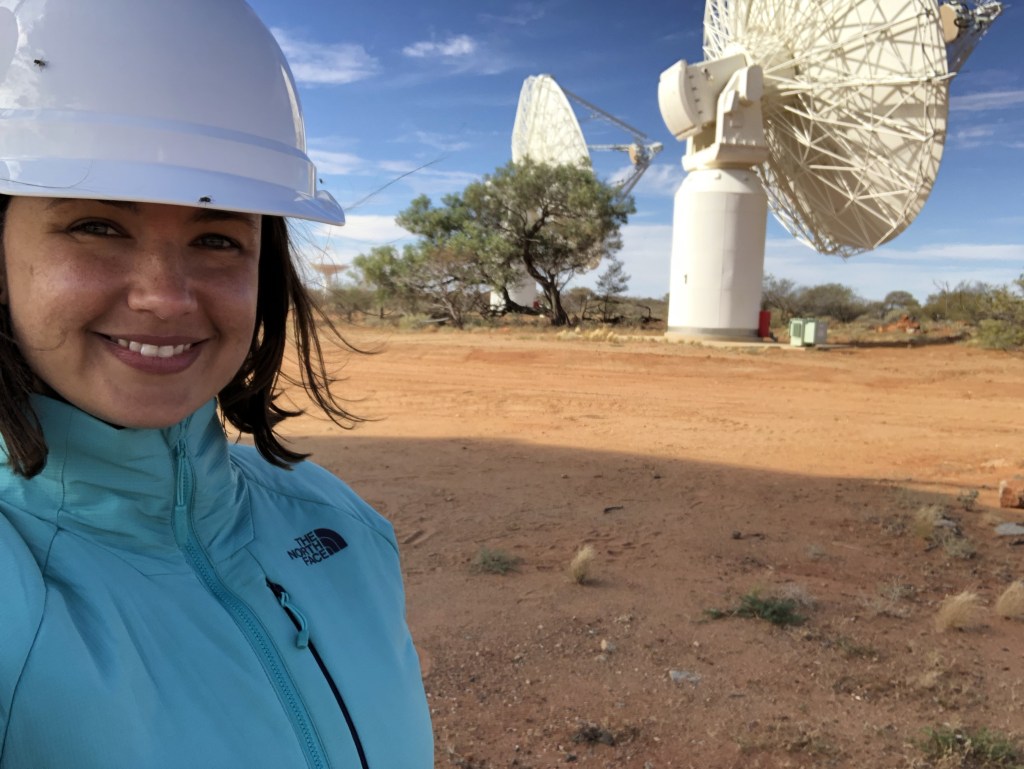
The ultra-sensitive image was created from more than 450 hours of observations on CSIRO’s Australia Telescope Compact Array (ATCA), on Gomeroi Country.
47 Tucanae has over a million stars and a very bright, very dense core. It can be seen with the naked eye and was first catalogued in the 1700s. But imaging it in such great detail allowed astronomers to discover an incredibly faint radio signal at the centre of the cluster that had not been detected before.
The researchers say the detection of the signal is an exciting discovery, and could be attributed to one of two possibilities.
One: 47 Tucanae could contain a black hole with a mass somewhere between the supermassive black holes found in the centres of galaxies and the stellar black holes created by collapsed stars.
While intermediate-mass black holes are thought to exist in globular clusters, there hasn’t been a clear detection of one yet. If this signal turns out to be a black hole, it would be a highly significant discovery and the first ever radio detection of one inside a cluster.
Two: the signal is a pulsar – a rotating neutron star that emits radio waves.
A pulsar this close to a cluster centre is also a scientifically interesting discovery, as it could be used to search for a central black hole that is yet to be detected.
To read the whole study, check it out here.
 Rae Johnston
Leave a comment